

Departmental Staff
- Joan Lindsay
- Aine Graham
- Oran McGranaghan
- Ciara Maguire
Department Overview
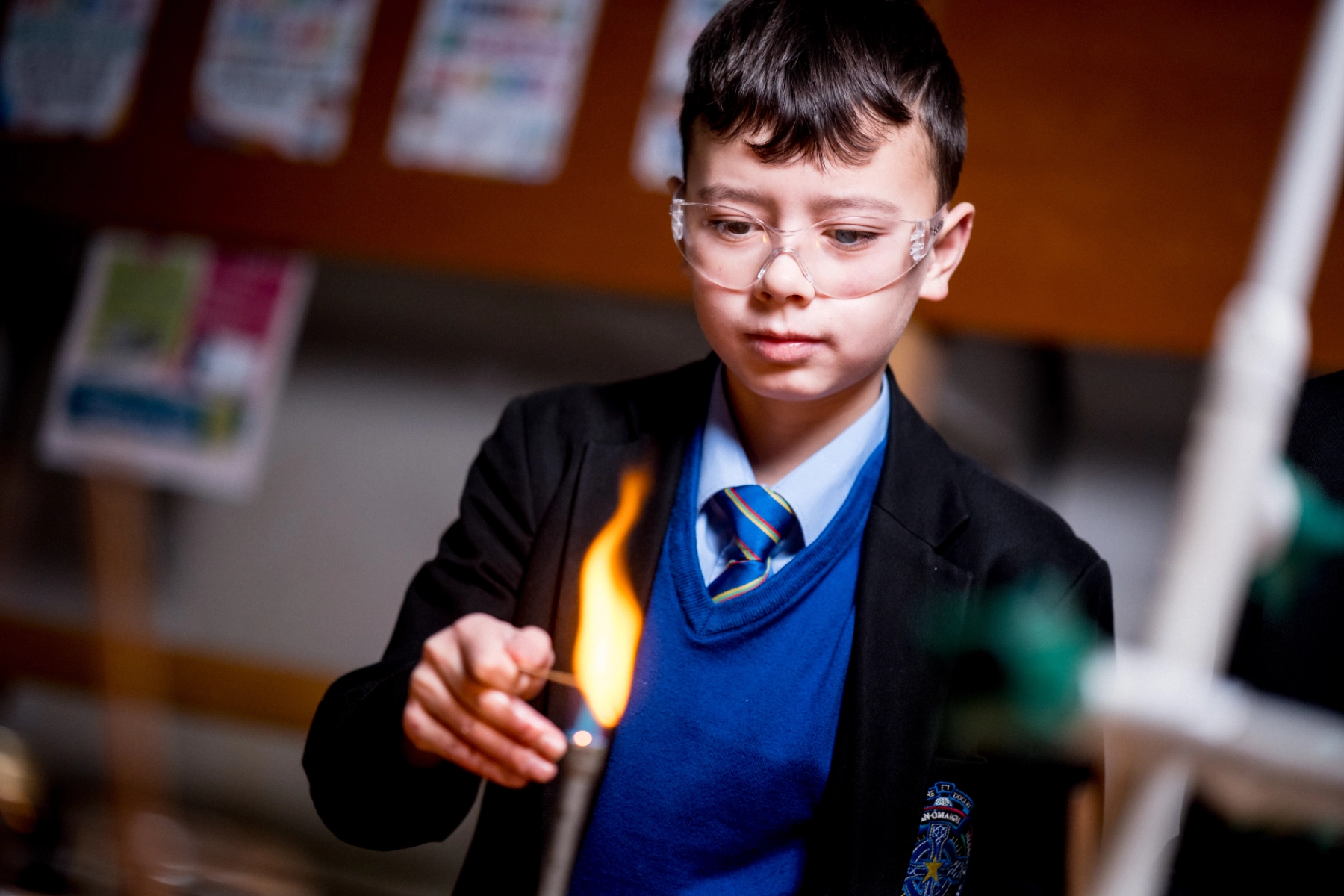
The Chemistry Department provides a dynamic and engaging curriculum that develops curiosity, practical skills, and scientific understanding. At Key Stage 3, Chemistry is taught within the Science programme, where students explore key topics such as states of matter, acids and alkalis, elements, compounds, mixtures, atomic structure, and reactivity. Emphasis is placed on hands-on learning, helping students build confidence in practical work while developing numeracy, literacy, and digital skills.
The department is committed to learning through practical experience, enabling students to understand the role of chemistry in the real world and develop strong enquiry and problem-solving skills.
Beyond the classroom, students can participate in Science Club, national competitions such as Top of the Bench, and enrichment events like the RSC Chemistry at Work showcase, where they explore future career pathways in chemistry.


Key Stage 3 - Overview
In Years 8, 9, and 10, Chemistry is taught as an integral part of KS3 Science. Students are introduced to the subject through engaging, practical experiences that encourage curiosity and develop investigative skills. In Year 8, they study States of Matter and Acids and Alkalis; in Year 9, Elements, Compounds, and Mixtures; and in Year 10, Atomic Structure and the Reactivity of Metals.
The curriculum is designed to build confidence in transferable skills, including numeracy, literacy, and digital competence, while providing a strong foundation for further study at KS4. Through hands-on experiments, students strengthen their mathematical understanding, practical techniques, and scientific communication skills.
Safety is a key focus throughout the course, with students learning how to handle chemicals and equipment responsibly in a laboratory setting.
Key Stage 4 - Overview
All students continue studying Chemistry at Key Stage 4 through either Double or Single Award Science, following the CCEA GCSE specification. Lessons are taught by specialist teachers. Double Award students sit a theory examination at the end of Year 11, while Single Award students complete their Chemistry unit in November of Year 12. In Year 12, all students take additional examination papers, including one focused on practical chemistry.
Throughout the two-year course, students complete a range of Prescribed Practicals to develop their laboratory skills. These culminate in a practical assessment that contributes to the Practical Skills Unit. The Chemistry Department at CBS strongly promotes practical, hands-on learning. Students develop a deeper understanding of the material world and the impact of chemistry on society, while building knowledge of scientific processes and how evidence supports theories and explanations.
Students strengthen their observational, practical, enquiry, and problem-solving skills across different learning environments. They also learn to critically evaluate scientific claims by analysing methods, evidence, and conclusions using both qualitative and quantitative approaches.
Key topics at this stage include organic chemistry, quantitative chemistry, and electrochemistry, supporting progression to further scientific study.
Post 16
To study A Level Chemistry, students must have achieved an A in GCSE Chemistry or in the Chemistry component of Double Award Science course.
Skills Developed
Studying Chemistry develops a logical and analytical mind and promotes development in many of the Key Skills. The work involved in A Level Chemistry develops a student’s ability to understand and han-dle complex concepts, to solve numerical and practi-cal problems, to use and manipulate a range of equipment. It also provides an opportunity for students to develop oral and written communication skills.
Career Opportunities
One of the most important reasons for studying Chemistry is the wide choice of careers it opens up. Chemistry is essential for many careers including the following: Medicine, Biochemistry, Chemical Engineering, Dentistry, Veterinary Medicine, Food Science, Environmental Science,Pharmacy, Agriculture, Food Technology, Chemistry and Industrial Chemistry.
| Content | Assessment | Weighting |
| AS 1: Basic Concepts in Physical and Inorganic Chemistry | External Written Exam- 1 ½ hours |
40% of AS 16% of A Level |
| AS 2: Further Physical and Inorganic Chemistry and an introduction to Organic Chemistry | External Written Exam- 1 ½ hours |
40% of AS 16% of A Level |
| AS 3: Basic Practical Chemistry |
External Written Practical Exam
& Internal Practical Assessment |
20% of AS 8% of A Level |
| A2 1: Further Physical and Organic Chemistry | External Written Exam- 2 hours |
24% of A Level |
| A2 2: Analytical, Transition Metals, Electrochemistry and Organic Nitrogen Chemistry | External Written Exam- 2 hours |
24% of A Level |
| A2 3: Further Practical Chemistry | External Written Practical Exam
& Internal Practical Assessment |
12% of A Level |
Beyond the Classroom
Beyond the classroom, Year 8 students can take part in Science Club, where they carry out fun experiments and investigations each week, encouraging curiosity and practical skills.
Students have also represented the school in the Top of the Bench Chemistry competition at Queen’s University Belfast. They completed a challenging programme of practical tasks, written tests, and a fast-paced quiz, demonstrating confidence, skill, and enthusiasm.
In Year 12, students attend the RSC Chemistry at Work event at Queen’s. This provides a valuable opportunity to meet professionals working in chemistry and explore a wide range of career pathways, both locally and across the wider region.